
The only thing that may salvage Narendra Modi's trip to the US is his meetings with CEOs, such as those of Blackstone, First Solar, Qualcomm, Adobe, and General Atomics, asserts Rajeev Srinivasan.

One looks upon the coming new year with foreboding as current wars in Ukraine and Gaza spill over and escalate and new ones erupt in incipient fault lines across the world, notes former foreign secretary Shyam Saran.

Describing India as an important member of the Quadrilateral Security Dialogue (the Quad) and a crucial partner for stability in the Indo-Pacific, the letter said that the lawmakers support the deepening strategic partnership between the two countries.
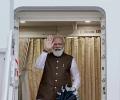
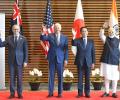
During his three-day visit, typically packed with appointments, Modi will address the United Nations General Assembly, attend the Quad Summit and meet with Joe Biden at the White House, their first meeting after Biden was elected America's president.

We can expect to see more Chinese wolf warrior diplomats on the prowl, in India's neighbourhood, though its mailed fist is not so visible while dealing with India, observes Colonel R Hariharan (retd).

Once the Canadian investigation runs its course, Ottawa may put on the public domain further accusations passing for "evidence" -- and that could happen at some point closer to our general election. All in all, the big question is, what is it that the US is really up to, asks Ambassador M K Bhadrakumar.

Modi and Albanese also reiterated their shared ambition for an early conclusion of the ambitious Comprehensive Economic Cooperation Agreement (CECA) that is expected to significantly expand bilateral trade ties.

External affairs minister S Jaishankar on Tuesday discussed issues relating to Afghanistan and the Indo-Pacific during his bilateral meetings with global counterparts on the sidelines of the annual high-level UN General Assembly session.

Modi will meet with Prime Minister Kishida Fumio during the visit.
India has the ability in all respects to be a great power and address our security challenges in the best national interests, says Commodore Venugopal Menon (retd).

Announcing the hotline, the Chinese defence ministry said as agreed upon by the defence departments of China and Japan, the two sides have recently completed the construction of a direct telephone line for the sea and air liaison mechanism and will maintain communication on the arrangement for the launch.
Expressing concern over the Russia-Ukraine conflict, India and Australia have underlined the need for an immediate cessation of hostilities and stressed that the contemporary global order has been built on UN Charter, international law and respect for States' sovereignty and territorial integrity.
Indo-Pacific region. Senior officials from the ministries of External Affairs and Defence, and the US departments of Defence and State met here for the India-US 2+2 Inter-Sessional meeting.

Pakistan is once again becoming a frontline State in big-power rivalry. But this time around, Pakistan stands to gain out of its geography, observes Ambassador M K Bhadrakumar.

Prime Minister Modi, who is in Japan on a two-day visit to attend a summit of the Quad leaders at the invitation of his Japanese counterpart Fumio Kishida, penned an op-ed on the vibrant relations between India and Japan in the Yomiuri Shimbun.

United States Secretary of State Antony Blinken during his maiden trip to India next week would meet Prime Minister Narendra Modi and External Affairs Minister S Jaishankar to discuss wide range of bilateral, regional and global issues, his spokesperson said on Friday.

In a statement just before leaving for the US, Modi said he will conclude his visit with an address at the United Nations General Assembly focusing on the pressing global challenges including the COVID-19 pandemic, the need to combat terrorism, climate change and other important issues.

Prime Minister Modi also made a veiled reference to China, saying the global order is based on the respect for the principles of the UN Charter, peaceful resolution of disputes, and respect for sovereignty and territorial integrity.

In an interview with Larry O'Connor, Pompeo said in his meetings with his counterparts from Japan, India and Australia, they began to develop a set of understandings and policies that can jointly take these countries to work to present a true resistance to the threats that the Chinese Communist Party poses to each of these nations.

It is difficult to recall an Indian minister in modern times pushing back at the US publicly, observes Ambassador M K Bhadrakumar.
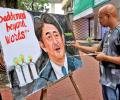
Prime Minister Narendra Modi will join several global leaders to pay tributes to Japan's slain former prime minister Shinzo Abe at his state funeral in Tokyo on Tuesday.
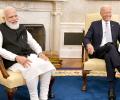
Prime Minister Modi will embark on his first state visit to the United States at the invitation of President Joe Biden and First Lady Jill Biden in June.

'Sullivan and Jaishankar welcomed the cooperation in recent weeks that resulted in deliveries of over USD 500 million in COVID-19 relief supplies from the US federal and state governments, US companies and private citizens across America for the people of India'

The Blinken visit indicated that the Biden administration is still somewhat tentative about the specifics of its relations with India, observes Ambassador T P Sreenivasan, who has served multiple stints at India's embassy in Washington, DC.

Four Indian quarter-milers running below 53 seconds augurs well for the country's hopes of winning six straight Asian Games gold in women's 4x400m relay since 2002.
United States Secretary of State Antony Blinken has said that he had a productive meeting with visiting External Affairs Minister S Jaishankar during which they discussed the bilateral ties, COVID-19 relief efforts, India-China border situation and Afghanistan and vowed to work together to address areas of shared concern.
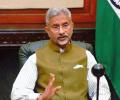
External Affairs Minister S Jaishankar will arrive in New York on Sunday to participate in the high-level 77th session of the UN General Assembly, which kicks off on September 20 with the opening of the general debate.

India would not be seen to be anything but rude with the Pakistanis. In the big picture, who is the bigger adversary right now? Who is the bigger pain in the neck? And who is it that is keeping more than 3,000 km of our borders active, throwing our military posture and deployments into imbalance? asks Shekhar Gupta.

President Biden underscored that the United States will 'continue to stand up for its interests and values and, together with our allies and partners, ensure the rules of the road for the 21st century advance an international system that is free, open, and fair', the White House said in a readout of the meeting.
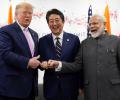
Prime Ministers Modi and Abe enjoyed a close and empathetic relationship and this certainly gave a sustained momentum to the India-Japan strategic partnership. It is necessary for India to reach out and engage with his successor as early as possible, advises former foreign secretary Shyam Saran.

Modi also gifted Harris a 'gulabi meenakari' chess set, the sources said, adding that the craft of 'gulabi meenakari' is closely associated with Varanasi, one of the oldest cities of the world and the prime minister's Lok Sabha constituency.
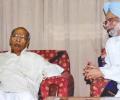
'Narasimha Rao asked me why China was doing so well in attracting foreign investments and I gave my frank opinion.' 'I told him that giving thrust to exports had to be a national effort.' 'But in India, the system was very centralised in the Government of India and the state governments had no role to play.'
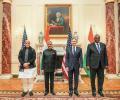
The pressure on India to take a hostile attitude towards Russia and China was not subtle, but it was guarded, observes Ambassador T P Sreenivasan after Monday's 2+2 ministerial meeting in Washington, DC.

'It is only when Beijing sees a country with an infirm political will such as India that it acts up as the PLA has done in eastern Ladakh.'
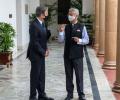
We do not know, because there has been no discussion, no transparency and most likely no real thinking on this matter at our end, observes Aakar Patel.

The Chinese coercion and aggression spans the globe, but it is most acute in the Indo-Pacific, it said.

Jaishankar, who arrived in Santo Domingo on his first official visit to the Dominican Republic, also said that India has seen a dramatic expansion in connectivity, contacts, and cooperation across the region.

As the United States focuses on the Indo-Pacific, in particular the Quad, the Biden administration needs to address India's ties with Russia and its 'downward trend of democratic values and institutions', said a report by the Democratic Party of the Senate Foreign Affairs Committee.

Asserting that India's dedication to climate commitments is evident from its performance, Prime Minister Narendra Modi on Monday hoped that rich countries of G-7 will support India's efforts in combating climate change and invited them to tap the huge market for clean energy technologies emerging in the country. In his remarks at the session on 'Investing in a better Future: Climate, Energy, Health' at G7 Summit, Modi highlighted India's track record and said it has achieved the target of 40 per cent energy-capacity from non-fossil sources nine years before time. "The target of 10 per cent ethanol-blending in petrol has been achieved 5 months before time.
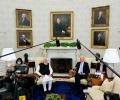
Prime Minister Narendra Modi met Joe Biden at the White House on Friday in his first bilateral meeting with the US president during which the two leaders are expected to discuss a wide range of priority issues, including combating Covid-19, climate change, economic cooperation as well as Afghanistan.
